> For the complete documentation index, see [llms.txt](https://docs.youquantified.com/llms.txt). Markdown versions of documentation pages are available by appending `.md` to page URLs; this page is available as [Markdown](https://docs.youquantified.com/educational-resources.md).
# Educational Resources
A MindHive Program @ New York University
## Program Overview
***YouQuantified*** gives middle- and high school students the opportunity to explore data generated by their own brains, bodies, and behavior. With the support of hands-on lessons that introduce them to basic principles of data, creative data visualization, and data ethics, learners will work with biosensing devices and [web-based creative coding tools](https://youquantified.com/) to develop their own representations of their brainwaves, heart rate, sweat, movement, voice, etc. They will pursue their own research questions and curiosity about the data they generate, contextualize their observations within population-wide patterns, and discover ways in which data plays a role across a range of STEM/STEAM careers by connecting with professionals who work with human data.
**Details**
* Funding: [US National Science Foundation’s Innovative Technology Experiences for Students and Teachers (ITEST) program](https://www.nsf.gov/awardsearch/showAward?AWD_ID=2241751\&HistoricalAwards=false),
* Lead institution and lead investigators: [Dr. Dikker](https://www.suzannedikker.net/), [Dr. Matuk](https://wp.nyu.edu/riddle/), and [Dr. Ochoa](https://steinhardt.nyu.edu/people/xavier-ochoa) at New York University.
* Age range: adaptable for both middle school and high-school aged children
* Format: adaptable for both formal and informal contexts (more below)
**Requirements**
* **Let us know that you are planning on using our tools.** Please note that if you plan to use any of our tools in your classroom, we do require that you set up an introductory meeting with our team. It is critical for us to know who is using You Quantified to (a) provide appropriate support and (b) for reporting purposes to our funders.
* **Participate in our research & program evaluation.** You will also be asked to participate in our educational research and program evaluation activities. While participation takes place on a voluntary basis, program evaluation is critical to keeping our project alive.
{% hint style="info" %}
**Contact us** at for more information or to set up a call.
{% endhint %}
## Program Tracks
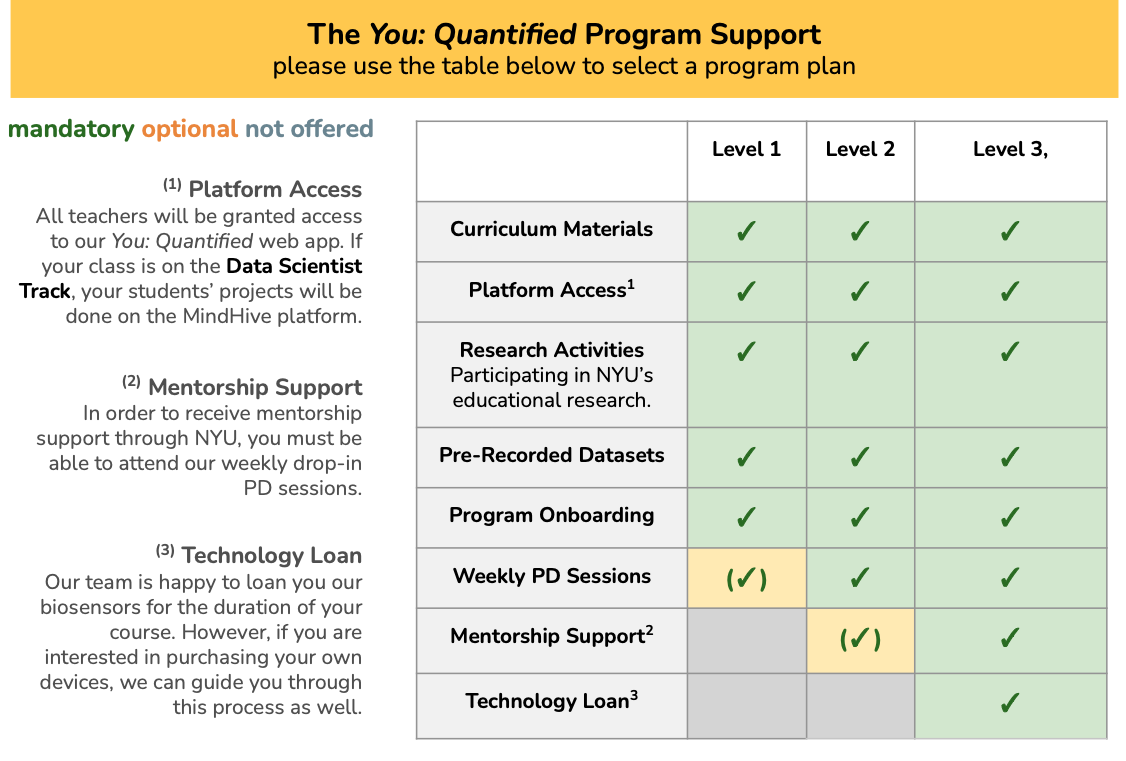
We currently offer four YouQuantified program tracks. Each has its own set of requirements. If you are interested in using YouQuantified in your course, please reach out to to discuss which track is best for you and which level of support you will need (see Support). Knowing who is using You Quantified is critical to keeping the project alive.
{% tabs %}
{% tab title="1. Data Explorer Track" %}
In the role of Data Explorer, students will construct a personal data biography /data autobiography (i.e. stories of how a dataset was produced and used). Students will engage in a series of activities in which they explore their identity through interpretation of brain, body, and behavioral data visualizations.
**Recommended class time:** 2-4 class periods
**Recommended support:** Level 1-2
{% hint style="info" %}
Example coming soon …
{% endhint %}
{% endtab %}
{% tab title="2. Data Maker Track" %}
In the role of Data Maker, students will develop either a creative data visualization of their own data or a data-driven application that others can use to visualize personal data. Students will explore the multiple purposes and strategies for data visualization and how digital applications draw on personal data from users.
**Recommended class time:** 6-8 class periods
**Recommended support:** Level 2-3
{% hint style="info" %}
Example coming soon …
{% endhint %}
{% endtab %}
{% tab title="3. Data Ambassador Track" %}
In the role of Data Ambassador, students will produce a data visualization and add a statement to their data biography that explores ethical decision-making around how data is collected and used.
**Recommended class time:** 6-8 class periods
**Recommended support:** Level 2-3
{% hint style="info" %}
Example coming soon …
{% endhint %}
{% endtab %}
{% tab title="4. Data Scientist Track" %}
In the role of Data Scientist, students will propose and run an experimental research study. Students will engage in a process of scientific inquiry and learn about experimental design.
**Recommended class time:** 10-12 class periods
**Recommended support:** Level 3
{% hint style="info" %}
Example coming soon …
{% endhint %}
{% endtab %}
{% endtabs %}
## Curriculum Materials
***YouQuantified*** comprises 10 modules that can be flexibly adapted as relevant and appropriate. Each module discusses a separate data source (e.g., brain, heart rate, voice, video, movement) in the context of meaningful exploration (e.g., attention in the brain, heart rate variability and emotions).
{% hint style="warning" %}
**Access to curriculum materials will be provided upon registration with our team at**
{% endhint %}
#### Each of our modules is divided into four sections: Explore, Learn, Create, Apply.
See sample slides from our program curriculum.
* **Explore**: Students are guided through exploring a given biosensing device, and are encouraged to think about what they notice and observe about the data they generate during this process.
* **Learn**: Lesson content is delivered, contextualizing student observations that might have emerged from their explorations.
* **Create**: Students engage in an exploration. With a given “exploration question”, students conduct a mini-experiment by collecting data and developing a visualization of this data – hand-drawn, or through our [You Quantified web-based app](https://creative-quantified-self.netlify.app/visuals/default).
* **Apply**: Students have the opportunity to connect with industry partners who work with datastreams discussed in the course, and to access career and college readiness resources relevant to these fields.
### Tools
**YouQuantified App**
The You: Quantified web app is publicly available. You can explore the platform and stream video and voice data. Authenticated users can also create their own projects and stream prerecorded brain and body data.
\
**MindHive Platform**\
MindHive is a platform designed to support teachers and students in carrying out independent projects. Within the platform, teachers and students can engage with tools, mentorship opportunities, and educational resources in ways that are designed to support multiple forms of participation with personal data.
***Conditions of use:*** While there are no restrictions in using the *YouQuantified* app or MindHive Platform, we ask that you contact us if you plan to use it for educational purposes (see above).
### Services
The MindHive team provides three levels of support for instructors who are interested in using the You:Quantified curriculum and tools. Level 1 participants agree to attend a virtual onboarding session and have the option to attend professional development and weekly drop-in meetings throughout the semester. Levels 2 and 3 participants are required to attend professional development meetings and weekly drop-in meetings throughout the semester. Please note that only level 3 participants will have access to our technology loan program.
**1. Professional Development (PD)**
We offer support through professional development and weekly office hours. Under some conditions, stipends and/or professional development credits can be made available.
***Conditions of use:*** Participating in professional development is a requirement for teachers who are interested in using biosensors in their classroom and for teachers who choose the Data Scientist Track. Contact us at
**2. Biosensors (limited capacity)**
We offer a biosensor loan program for teachers who agree to participate in a professional development program and receive in-class support from mentors. Teachers who participate in this program will have access to biosensing devices, including headsets that measure brainwaves (EMOTIV and Muse) and physiology (Emotibit).
***Conditions of use:*** If you plan to use biosensors in combination with YouQuantified, contact us at . Loans and support will only be provided to teachers who participate in our professional development and mentorship program.
**3. Mentor Support (limited capacity)**
We offer live support by professional neuroscientists who can help your students with their projects.
***Conditions of use***: Mentor support is a requirement for teachers who use biosensors in their classroom, and highly recommended for teachers who participate in the Data Scientists Track. Mentor support is conditional upon participation in our professional development sessions.